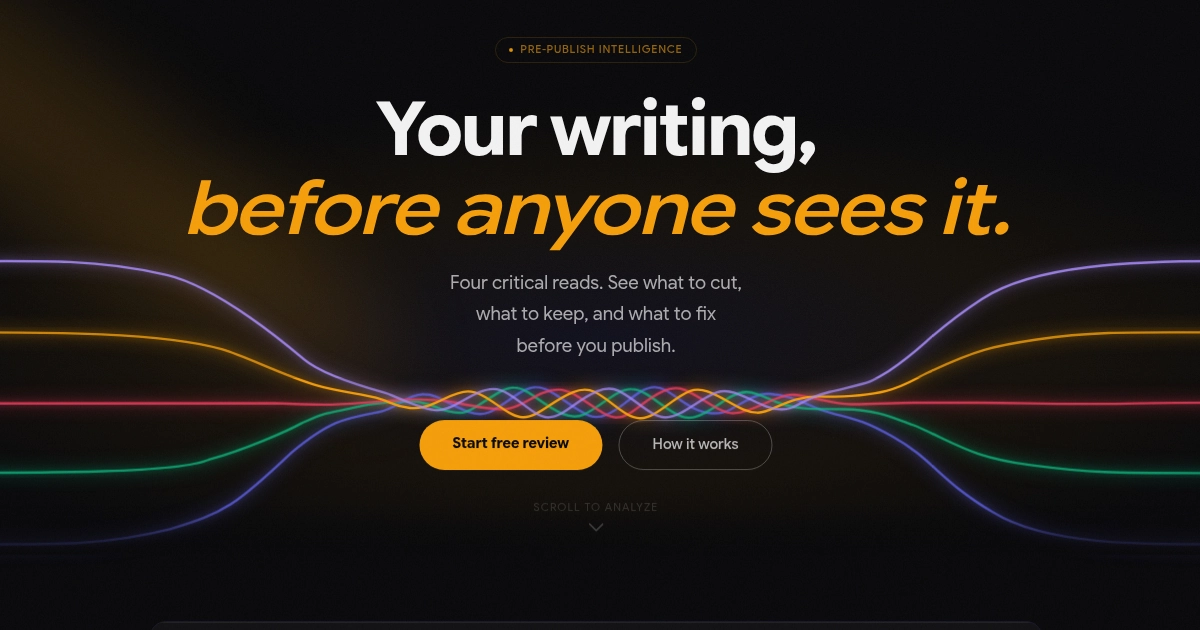
Obliqo is live — use it, break it, tell me what actually happens! 😁🎉

I built something new.
👉 https://obliqo.pyragogy.org/
It’s in pre-launch.
It works. It still needs testing, pressure, and real use.
For the next few days, you can use it with free credits.
I’m not asking for applause or polite comments.
Use it.
Test it on something real.
Then tell me what actually happened.
What Obliqo is
Obliqo is not another AI tool for generating content.
It’s a place where you take something you’re about to send, publish, or share — and put it under pressure first.
That could be:
- an idea
- a blog post
- an email
- a message
- a project description
- a piece of writing
The goal is simple:
catch weak points, ambiguity, and avoidable mistakes before exposure.
Something closer to a real colleague than an assistant.
- it is designed not to flatter you
- it pushes back when things don’t hold
- it tries to surface what is weak, unclear, or missing
Not to destroy your work.
To make it stronger before it leaves your hands.
A simple example
I started from a broader direction:
“Build a system for public AI-driven peer review”
What emerged was not just excitement, but friction:
- the target user was unclear
- the model depended too much on public engagement
- the incentive to participate was weak
So I reduced the scope.
Less public exposure.
More control.
More direct usefulness.
That shift became Obliqo.
Where this comes from
Before Obliqo, I built this:
👉 https://open-review.pyragogy.org/
The idea was to run content — especially Peeragogy Handbook chapters — through a multi-agent review process that could:
- highlight contradictions
- challenge assumptions
- suggest possible directions
- open space for constructive comparison
At least, that was the intention.
What happened
I shared it.
And almost nothing happened.
No real feedback.
No discussion.
No visible follow-up.
Just silence.
My current hypothesis
I may be wrong, but this is what I’m testing:
Public critique is often harder to engage with than private critique — especially when the work is unfinished, exposed, or tied to reputation.
So Obliqo is my attempt to test a different path:
private pressure first,
public sharing later — if it still makes sense.
I’m not claiming this solves the problem.
I’m testing whether it helps.
Why this might be useful
Sometimes the problem is not writing something.
Sometimes the problem is not knowing whether it holds.
Before you send an important email, publish a post, share a page, or present an idea, there is often a gap between:
- what you think is clear
- and what actually survives pressure
Obliqo is meant to sit in that gap.
Not as a final judge.
As an intermediate pass.
How to use it
- Take something real that you are about to share
- Run it through Obliqo
- Look at where it cracks, weakens, or becomes vague
- Decide what to change — or what to keep
No ceremony.
Just pressure, reflection, and choice.
If we do this the Peeragogy way
Instead of generic feedback, we can approach this as a
PAR (Paragogical Action Review).
Not opinions.
Not validation.
A reflection grounded in actual use.
1. What was supposed to happen
- What were you trying to do?
- What did you expect Obliqo to help with?
2. What actually happened
- What did Obliqo return?
- What surprised you?
- What felt relevant?
3. What worked / what didn’t
- What helped?
- What broke?
- What felt weak, confusing, or useless?
4. What did you learn
- Did your work improve?
- Did you remove something?
- Did your perspective change?
5. What should change next
- What would you change in Obliqo?
- What would you test differently next time?
What kind of feedback would be useful
The most useful feedback is not:
- “nice tool”
- “interesting project”
- “cool idea”
What helps is something like:
- I used it on a blog post, and it caught X
- I used it on an email, but the feedback felt too vague
- I expected Y, but what I got was Z
- I changed these two things after using it
- I would use it again / I would not use it again, because…
That kind of feedback is gold.
Why I’m posting this now
Because this is the phase where reality matters more than theory.
I’m outside my comfort zone here.
I’m building, testing, adjusting, and learning in public — even if the tool itself is meant to help people think better in private first.
If Obliqo is useful, I want to know how.
If it fails, I want to know where.
If it is almost useful but still incomplete, that matters too.
Your turn
👉 https://obliqo.pyragogy.org/
Use it on something real.
A post.
A mail.
A text.
An idea.
Something you are actually about to expose.
Then tell me what happened.
Final note
Some things will still be rough.
Some parts will change fast.
That’s not a bug in this phase.
That’s the work.
If it helps you think better before you expose your work, it stays.
If it doesn’t, it evolves.

Pyragogy AI Blogger